Swimming Pools
Gunite pools · Guide
What is gunite, and how it differs from shotcrete and poured concrete
Gunite is the material most custom concrete pools are actually made of, and the word confuses almost everyone who hears it for the first time. This guide explains what goes into a gunite pool shell, how it is applied, and how it relates to shotcrete and ordinary poured concrete.
Gunite is the dry-mix form of sprayed concrete: cement and sand travel through the hose dry, take on water only at the nozzle, and land on a steel rebar frame to cure into a pool's reinforced shell.
What is a gunite pool made of?
A gunite pool is made of steel-reinforced concrete that arrives at the site as a dry cement-and-sand mix and only becomes wet concrete at the nozzle, a moment before it hits the rebar. River Pools (2025) describes gunite as a dry concrete mix that picks up water at the end of the nozzle as it is sprayed onto its final surface. The dry ingredients are pushed through a hose by compressed air, wetted only at the tip, and the wetted mix hits the steel frame at speed. The American Concrete Institute defines shotcrete as concrete placed by high-velocity pneumatic projection, and that velocity compacts the material as it lands.
The word itself is older than most people expect. The American Concrete Institute treats gunite as the historic trade name associated with the dry-mix version of pneumatically applied concrete, which the industry now calls shotcrete. In pool construction the old name stuck, so "gunite pool" and "shotcrete pool" often describe the same kind of shell: steel-reinforced concrete, sprayed rather than poured.
What gunite is not: it is not a coating, a plaster or a liner. It is the structure. The plaster, quartz, pebble or tile surface that swimmers touch is a separate finish applied later over the cured shell.
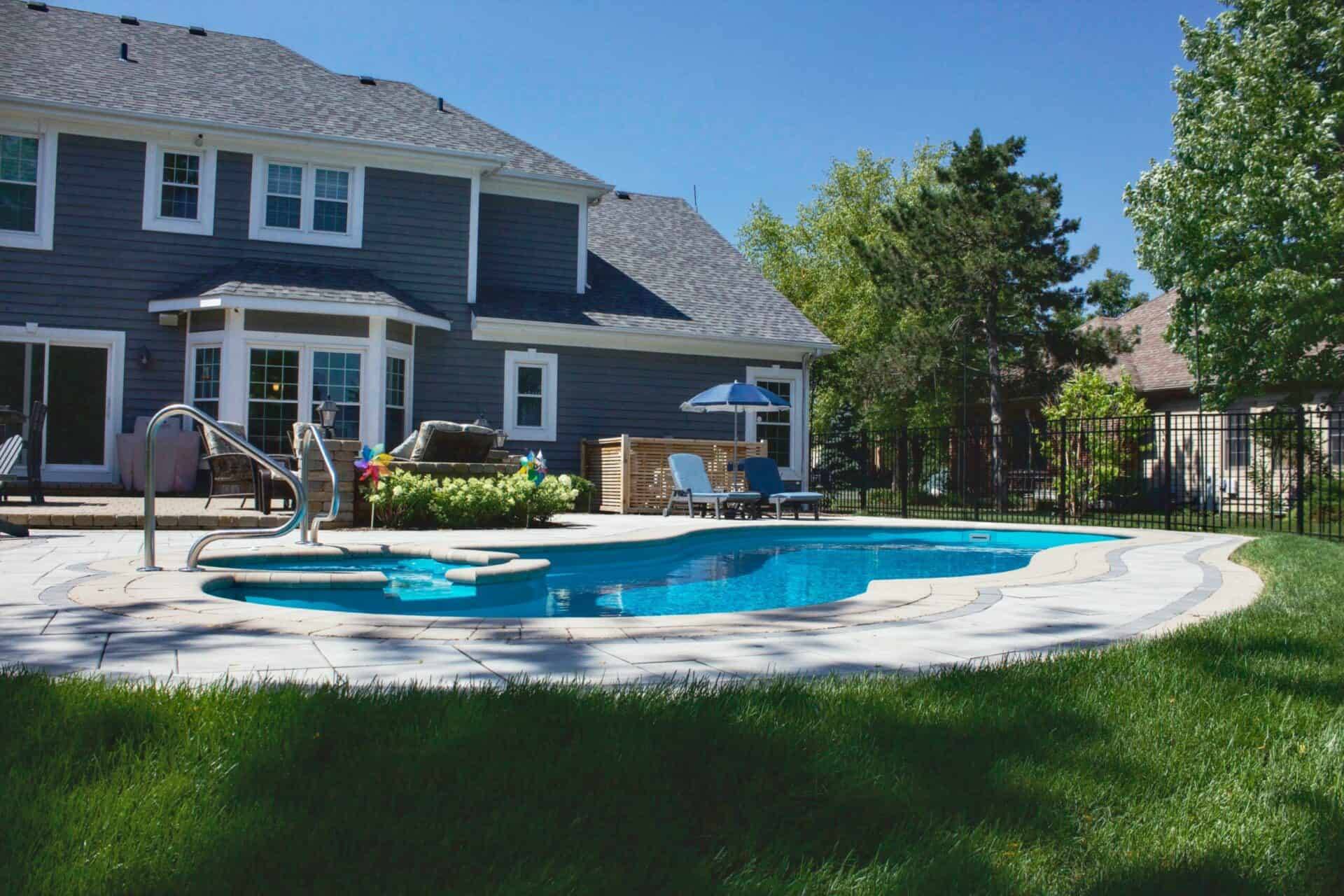
How a nozzleman builds the shell, one pass at a time
The nozzleman builds the shell by spraying layer over layer onto a tied steel rebar cage, working from the floor up once the excavation is complete and the plumbing is already in place through the steel. That cage has been tied to the exact form of the pool, including every step, bench and curve, so the sprayed material takes that shape as it lands. Another worker follows the hose with a cutting rod and trowel, shaving the fresh material back to the designed thickness and profile.
Control at the nozzle is the whole craft. Because wetting happens only at the tip, the nozzleman adjusts it continuously. Too dry and the material will not bond; too wet and it sags off vertical walls and loses strength. Rebound, the material that bounces off the steel and falls to the floor, is cleared away rather than reused, because it no longer has the right mix.
When the spraying is finished, the shell is complete as a structure, with the walls, floor, steps and any attached spa formed in a single continuous piece of steel-reinforced concrete. There are no seams between wall and floor.
Gunite vs shotcrete: where the mix gets wet
Gunite is the dry-mix form of sprayed concrete, wetted only at the nozzle, while shotcrete is the broader term for concrete placed by either a wet- or dry-mix process. Both are shotcrete in the American Concrete Institute's vocabulary, and both produce a reinforced concrete shell; the composition is similar, and the point at which the mix is wetted is what separates them.
In practice the methods are chosen for different reasons. Builders who favor dry mix usually point to that on-the-spot control of the mix for detailed, sculpted work; builders who favor wet mix usually point to consistency, since the moisture content is set before the material reaches the hose. Which method a builder uses depends on the crew, the equipment and the design, so ask which is planned for a specific pool and why.
Concrete vs gunite: poured forms against a sprayed shell
Poured concrete is the other relative. A poured pool uses forms, wooden or metal molds that hold liquid concrete until it sets, and the result is a shell with flat planes and seams where the forms met. Sprayed concrete needs no forms, and unlike a fiberglass shell it arrives with no form at all, so the steel cage alone defines the geometry, which is where the design freedom of a custom concrete pool comes from. The material is concrete either way; the application method is what differs.
Why the dry-mix process matters for shrinkage control
The dry-mix process matters for shrinkage because it lets the nozzleman limit water to what the cement needs at the moment of placement, and excess moisture is what drives concrete to shrink and crack as it cures. The wetter a mix runs beyond what the cement needs, the more it tends to shrink and the more hairline cracking can follow, which is the practical reason the method is prized for pool shells. Exact mix ratios and shrinkage comparisons vary by crew, mix and conditions, so ask the builder for the mix design used on a specific project rather than relying on a general figure.
Curing is the other half of shrinkage control. River Pools (updated 2025) puts the cure for gunite at roughly one month before the concrete has fully bonded, and In The Swim attributes most plaster-surface shrinkage cracking, the fine crazing pattern, to insufficient curing time or letting the surface dry out in hot weather. Keeping the fresh shell damp through that period, rather than letting it bake in summer sun, is the routine safeguard, and it is a fair question to ask any builder how the cure is managed. Cracking is covered in its own guide in this series.
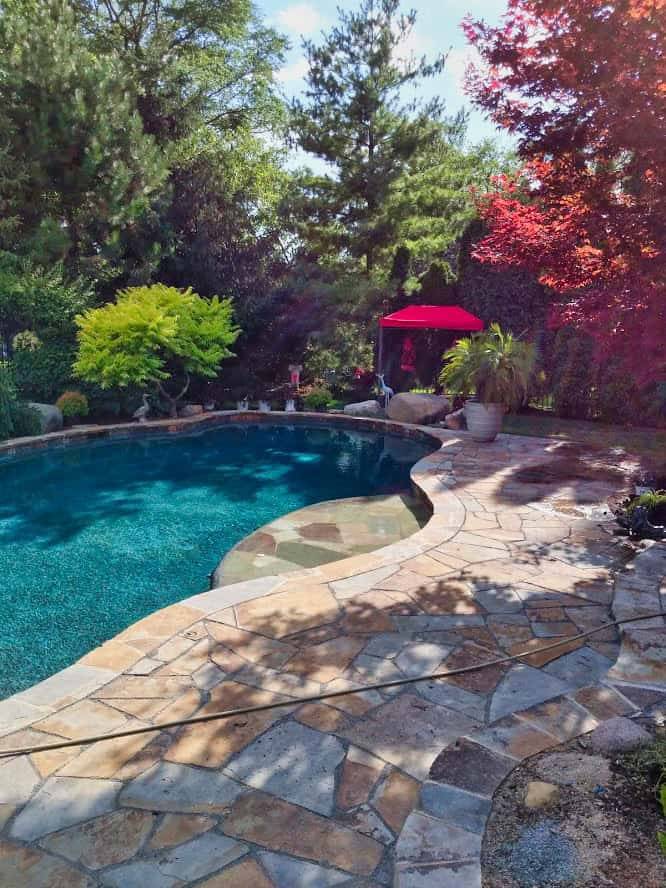
What happens after the shell cures
Once the gunite has cured, the shell is structurally finished but not yet a swimming pool. The waterline tile and the coping are set, the deck is built around the edge, the equipment is connected, and then the interior finish goes on: plaster, a quartz or pebble aggregate blend, or tile. That finish is what gives the pool its color and texture and what swimmers feel underfoot; the gunite beneath it is never visible again. The finish families are compared in their own guide in this series.
The finish coat is also the part that will eventually be renewed, while the shell beneath it is designed to carry on. The American Concrete Institute states in ACI PRC-506.8-24 that a properly designed, material-selected and constructed shotcrete pool can have a service life of 50 to 100 years or more. That is an industry reference conditional on design and construction quality, not a warranty for any particular pool.
Choosing a concrete pool builder who knows the material
Because gunite is made on site, at the nozzle, by people, its quality depends on the crew more than on the brand of cement. That changes what a homeowner should ask pool builders. Who runs the nozzle, and how long has that crew worked together? Is the shell dry mix or wet mix, and why? How is the cure managed, and for how long? What thickness is specified in the drawings, and who verifies it? A builder who answers those plainly understands the material; one who waves them off is asking for trust the material does not extend on its own.
Understanding what gunite is also makes it easier to see why it is the custom path in concrete pool installation: a sprayed shell can follow any form the steel is bent to, which is the freedom the installation page describes. That page is where the decision moves from what gunite is to whether a gunite pool is right for a particular yard and budget, and what a conversation with Wave Outdoors Pools covers.
Sources: River Pools (2025); River Pools (updated 2025); American Concrete Institute (shotcrete topic page and ACI PRC-506.8-24); In The Swim
Ready to see what a gunite pool involves?
The installation page explains how Wave Outdoors Pools approaches a custom concrete pool and what the first consultation covers.